28.6.09

CWU Dispute - Irvine


COMMUNICATION WORKERS UNION

Glasgow & District Amalgamated Branch

Tam Dewar CWU Area Delivery Rep DG/KA

The last national Postal strike in 2007 was concluded when the CWU and Royal Mail agreed a process to negotiate change in response to new technology. This Pay and Modernisation Agreement, endorsed by 60% of the membership, laid out a four phase process to conclude by April 2009 in a new pay and reward scheme and methods of working in Delivery.

From 2007 till 2009 the CWU agreed changes locally through the PMA which resulted in massive savings to Royal Mail. Some units were rewarded by a 50/50 bonus scheme, most units received no bonus. Lump sum awards and a 1.5% increase in basic pay in 2008 was largely self funded. Royal Mail has now walked away from the final phase of this Agreement, not only announcing a pay freeze, at a time of growing company profits, but introducing changes to working practises which affect members earnings and job security. Royal Mail have a view of future delivery jobs being largely part time.

The recent CWU national conference in Bournemouth was dominated by requests for industrial action from units throughout the UK in response to Royal Mail’s misuse and eventual abrogation of the Pay and Modernisation Agreement. Many members feel that if Royal Mail can walk away from this agreement then the CWU should declare the PMA dead and return to established ways of working. It is worthy of note that the Postal Executive which endorsed this Agreement was returned to office with around 10% of the membership voting.

Postal workers in the East of Scotland were the first to use the collective power of the CWU to resist the RM model of “Modernisation” spreading eastwards. Their action had such an effect on the service that Ayrshire managers (members of Unite) were ‘drafted’ to deliver mail. Now that members from the Ayrshire Coast will take to the picket line to explain their case, these managers will be occupied in Ayrshire.

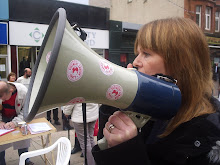
Members in my home unit of Irvine took strike action on Saturday 20th June in response to Royal Mail managers who ignore agreements with the Union on working practises, only after months of talks at local level have been exhausted.

This may well be a prolonged action given the complete inability or unwillingness of senior RM managers to pay due regard to the wishes of the men and women who deliver and collect the mail. Although Irvine DO is the first to take action they will be followed by other units in Ayrshire unless Royal Mail negotiate “modernisation” plans.

Although the Irvine strike is local, in that it concerns the abuse of working practises and the intimidation and threats against senior serving and part time staff, it illustrates the attitudes of RM managers to national and local agreements. We need the protection, at local bargaining level, of a strong Union with national bargaining power.

In addition CWU members face the possible “Part Privatisation” of Royal Mail by a Labour Government elected with a mandate from the British electorate to maintain RM in public ownership. Likewise the Leadership of the CWU believed they had a similar commitment from the Labour Party through the “Warwick Agreement”.

My old Aunt, who read palms and tea leafs, had more accurate powers of prediction than the Leadership of the CWU have managed over what Labour will do next. Prior to the release of the Hooper report we were told that the CWU had a good working relationship with the Business Secretary John Hutton and that Labour would fulfil the “Warwick Agreement”. The very next day Hutton was replaced by Lord Mandelson, “Warwick” was forgotten and Labour intended to privatise Royal Mail. At a briefing in May we were told that the Prime Minster need CWU help out of the privatisation hole, Mandelson would be moved and the CWU view would prevail. Less than two weeks later the PM’s jacket is on a slack nail and Lord Mandelson rules supreme, showing no sign of backing off Privatisation. Not a lot of return for the £1m of CWU members money flowing into Labour coffers. On a more positive note the CWU have run a faultless campaign to influence the public and politicians on Royal Mail privatisation. It would make more sense to spend the political fund on more of the same as the legislative programme rolls on.

That it should be a Labour Government which proposes privatisation of Postal jobs holds it own paradox for Irvine workers. A clandestine meeting of the newly formed Ayrshire Miners Union met on Irvine Moor in 1887 to adopt resolutions advocating “the formation of a Labour Party in the House of Commons“. The Ayrshire miners, following the lead of James Keir Hardie, realised that industrial strength and political representation of the working class in parliament were necessary to change society for the better. Now that the political representation has been corrupted, despite the views of ordinary Labour members, we depend even more on our industrial strength to defend jobs and conditions.


Tam Dewar
(in a personal capacity)

8.6.09

SOCIALIST LABOUR PARTY EUROPEAN ELECTION RESULT

The Socialist Labour Party has achieved a stunning vote in the European Union elections. It has polled more than 20,000 more votes than the coalition known as NO2EU which was supported by the RMT, CPB and a variety of other so called "Left organisations". All who really want the UK to remain in the European Union.

The Socialist Labour Party was the only Socialist Party in this election which called for the total withdrawal from the European Union and at the same time called for the building of a campaign to establish Socialism in the U.K.

Socialist Labour Party Leader, Arthur Scargill, said that "the result was a substantial increase on the Party's performance in the 1999 European Union election and represents a lesson that all those who claim to be socialist but who seek to remain within the European Union which is the epitome of Capitalism and the free movement of capital and labour".

Arthur Scargill congratulated all comrades within the Socialist Labour Party and in particular the magnificent achievement of our comrades in Scotland whose policies won the support of all those who want to shake off the shackles not only of the European Union but also of a rotten, corrupt, bankrupt capitalist society.

Ends.

7.6.09

Irvine Meadow celebrate as 2 - 1 Ayrshire Cup winners over Auchinleck Talbot. Before the game the West of Scotland Premier League Champions trophy was presented.

Onwards to the Scottish Cup next season !

Meadow manager Chris Strain celebrates with the trophies in Irvine's Porthead Tavern after the match.

16.5.09

Hungary Tears Up the Ballot Paper

by Neil Clark

His approval ratings are among the lowest ever achieved by a prime minister. As the former manager of the country’s finances, many blame him for its current economic predicament. By nature an introvert, he is finding it hard to build up a rapport with the electorate. His name is Gordon B.... No, not Gordon Brown, but Gordon Bajnai, who last month was sworn in as the new prime minister of Hungary.


The similarities between the political situations in Hungary and Britain are striking. In both countries a nominally left-of-centre – but actually pro-big business and pro-privatisation – government has presided over an unsustainable credit boom. Both have been hit hard by the global recession. We should also note that Bajnai’s predecessor, Ferenc Gyurcsány, was widely referred to as “Hungary’s Tony Blair” and is a friend of Peter Mandelson.

But there are important differences, too. Britain’s Gordon B may not have had his elevation to the premiership endorsed by the electorate, but he is nonetheless a democratically elected member of parliament. Hungary’s Gordon B has not been elected to any office.

A millionaire businessman, nicknamed “Goose Gordon” for his controversial role in the liquidation of a poultry firm in which hundreds of producers lost their savings, Bajnai became prime minister due to the support of the neoliberal SZDSZ party (Alliance of Free Democrats), who despite having the support of only 1 per cent of the electorate, according to recent opinion polls, hold the balance of power in parliament.Bajnai is not a member of any political party, but a friend and former business partner of both Gyurcsány and the SZDSZ leader, János Kóka.

Imagine if in Britain the Lib Dems held the balance of power in the next parliament and Nick Clegg installed an old business buddy, who was not an MP, as PM.It sounds far-fetched, but it has happened in Hungary. Realising that they stand little chance of winning seats in the next election, the SZDSZ, who reacted angrily when voters in a referendum last year rejected the imposition of hospital and doctor’s visit fees and higher-education tuition fees, have been pushing for a “government of experts” to impose the draconian cutbacks in public spending that they have long advocated. Now they have got what they wanted.In addition to the prime minister, other unelected “experts” in the new government include finance minister Peter Oszko, formerly head of Deloitte Hungary; economy minister István Varga, the former head of Shell in Hungary; and minister of transport, telecommunication and energy, Peter Honig, the former CEO of the airline Malev.

The fact that unelected figures hold so much power in a European country that styles itself a democracy is alarming. The formation of “non-political” governments to introduce swingeing cuts in public expenditure – and privatise health care, lower pensions and drastically reduce welfare provision – is an undemocratic development that could spread.Such governments are a long way from being “non-political”. On the contrary, they are espousing ideologically motivated economic policies, but do so under the smokescreen of “financial necessity”. Unable to receive a popular mandate for their reforms, neoliberals in Hungary have stuck two fingers up at the democratic process. As the economic crisis deepens and public unrest grows, don’t rule out their counterparts in other countries

This article first appeared in the New Statesman 14th May 2009.

Neil Clark will be speaking at the Hay-on-Wye festival in Wales on 23rd May 2009.

Scroungers, Parasites & the Crisis of Capitalism.


A Comment by Ian Johnson

The recent expenses scandal, which has at the last count covered over 400 of the 646 Members of Parliament, cannot fail to appal and disgust all who have followed, even in passing, the nauseating details.

Prime Minister Gordon Brown said, “I want to apologise on behalf of politicians, on behalf of all parties, for what has happened in the events of the last few days.”
The last few days? As we now know this scrounging from the public purse has been going on for years!


The politicians meekly whisper that the expenses claims are necessary for them to function properly as MPs. However, claims for moat cleaning, chandeliers, mansions, non-existent mortgages, non-existent cleaners and gardeners, stables, three homes, right down to bath plugs and pornographic films among countless other such abuses, are not, even with the widest stretch of the imagination, essential to the job of representing their constituents.

Communities’ secretary Hazel Blears stood in front of the television cameras, not to apologise, but to wave a £13,332 cheque proclaiming “Look, I am paying it back”

The cheque was for capital gains tax which Blears had not paid on the sale of one of her homes, yet she insisted she had done nothing wrong and she had acted within the rules. Apart from the fact that MPs themselves make the rules, what follows from Hazel Blears’ action are two things: One, if she has done nothing wrong and everything is legal and above board, why on earth would she send the Inland Revenue a £13,332 cheque, and why would they accept it? Two, if indeed she has avoided paying what she was legally obliged to pay then that is surely a criminal offence and should be prosecuted as such. If memory serves correctly, Al Capone got a seven- year sentence for tax avoidance.

Blears was one of a host of new MPs that came into Parliament in 1997 on the back of Blair’s election victory. The mantra at that time, emanating from the very top, was that any MP who serves a full term and does not come out as a millionaire is a failure.

Although abuse of the expenses system, no doubt by all the main parties, has always been a factor, the sheer greed and avarice that is now exposed to the general public was crystallised by the philosophy that accompanied the election of Blair’s Labour party in 1997.

These cross-party exposures reveal who the real scroungers and parasites in society are. In comparison, the example of a person working a part-time job to supplement meagre benefit payments and claiming a few pounds more than they may be entitled to, pales into insignificance. Perhaps MPs should be subject to the same interrogation, demeaning treatment and obstacles that are endured by workers who dare to try and claim benefits? Then again, this is not about fairness, but about class.

Background

In November 2008 all MPs were warned to get their expense claims in order because of the changes in ‘transparency’ that would eventually be introduced. They were asked to accomplish this ‘cleaning up’ exercise by July 2009, so that by the time the general public had access to the information, there would be nothing untoward to discover. One can ponder the deceitfulness of this but another question is of more interest.

The MPs expenses scandal was exposed by the Daily Telegraph. The Telegraph had hold of this story for some time, yet it chose to publish it in the run-up to the European elections when it must have been fully aware of the damage it would cause to all the main three political parties.
The Daily Telegraph is a right-wing newspaper; historically it has always displayed a sharp ruling class consciousness and has close links to the machinery of the state itself. Why then would it publish at the time it did?


Almost every television and radio debate and almost every serious newspaper article covering the recent revelations give a clue as to why. All intimate that the beneficiaries from the fallout of the scandal are expected to be the extreme right-wing parties. Such a development is no accident.

The fact that the Telegraph did publish the story at this time is a reflection of a split within the ruling class. The Telegraph is expressing the thoughts of the most reactionary section of that class, and is creating the conditions whereby the question can be posed that a strong authoritarian force, capable of sweeping away corruption and sleaze, similar to the cleansing of the Weimar Republic in Germany, is surely worthy of consideration?

It does not explicitly state this of course, it has no need to. And if creating such an atmosphere means sacrificing a few MPs on the way then so be it.

However, why does the Telegraph and the section of the ruling class it represents feel a more authoritarian government is needed merely to sort out a group of grubby, parasitic MPs?
This question cannot be answered by considering the MPs scandal in isolation. It is but one part of an entire process which flows from an understanding by sections of the ruling class who realise that attempting to lay the full burden of the developing economic crisis onto the backs of workers will result in ‘domestic unrest’ and a government, possibly a ‘strong’ national coalition government, would be required to accomplish the task of controlling this unrest and completing the job of pauperising the working class in order to save their profit system.


No Recovery

Recent statements by Chancellor Alistair Darling and Mervyn King of the Bank of England, in relation to economic recovery have been ridiculed by the IMF and World Bank, who are predicting that the UK will be the hardest hit of all developed nations as the crisis gathers pace.
Already within the European Union suggestions are being made that only emergency cases should be treated under the NHS, while all other treatments should be paid for.


Unemployment has now soared to officially 2.2 million, unofficially to 7 million, and will increase further, throwing millions more onto benefits that this government, with its cuts in public expenditure, will not financially cater for. Tellingly, the last time the UK had a national coalition government its first act was to cut the dole.

The ruling class desire for ‘a strong government’ should be seen together with developments in policing, such as the tactic of ‘kettling’ people at perfectly legal demonstrations, the introduction of the shoot to kill policy and the recent creation of the Confidential Intelligence Unit (CIU) who’s remit is to spy on and organise surveillance of ‘domestic extremists’ and to address any “threat to public order”.

‘Domestic extremists’ include, as journalist Seamus Milne discovered, “groups such as those involved in the recent Gaza war protests, trade unionists taking part in secondary industrial action and animal rights organisations.”

It must also be remembered that anti-terrorism laws are now in place that will be used, not against terrorists in the generally accepted sense, but against people and groups as described by Milne. Furthermore, at the 30th March G20 summit people were arrested under the Terrorism Act for “possessing material related to political ideology.”

This is the future that sections of the ruling class are preparing.

Will the current wealth – seeking, morally bankrupt set of Labour MPs resist these developments? On the contrary, it was the Labour party that introduced the National Public Order Intelligence Unit in March 1999 from which the CIU operation has originated from. The difference being is that the CIU operates outside any parliamentary oversight and is not held accountable as it will not be subject to the Freedom of Information Act. Yet many trade unions leaders still financially support the Labour party with significant contributions of their members money, which is the equivalent of saying to the government “here is some more money, please go out and buy a bigger hammer so you can hit our members harder.”

Considering the above developments, it is important to note that the danger of fascism does not originate from any extreme right-wing group, it stems from the state itself, who will use such groups as and when it deems fit. In general the ruling class would prefer to rule via parliamentary democracy but in times of crisis they are perfectly willing to introduce and finance a different type of rule.

It is not the duty of socialists to ignore developments and deny reality, but to analyse them and to prepare and build a Party that can offer an alternative to the nightmare scenario that is currently unfolding brick by reactionary brick.

Ian Johnson is General Secretary of the Socialist Labour Party.

VOTE SLP

May 2009.

8.5.09

SOCIALIST LABOUR PARTY TO STAND IN EUROPEAN ELECTIONS


The SLP has announced that they will be standing a full slate of candidates in the forthcoming European elections being held on 4th June 2009. All nine regions in England plus the Scotland and Wales regions will be contested.

The EU is a capitalist club that makes it easier for the multinational companies to exploit workers throughout its member states. Factories are uprooted from one country to another in pursuit of the cheapest labour, without any social responsibility being accepted towards the devastated communities they are leaving behind.

Moreover, EU directives on privatisation are destroying Britain’s health, education and postal services and now there is no part of the economy safe from the hands of the privateers.

The Socialist Labour Party is totally committed to complete withdrawal from the European Union. However, the SLP recognises that the EU is but one instrument of capitalist rule; therefore what is ultimately needed is a genuine socialist alternative to the vast array of problems that workers and their families are facing today.
The SLP is the only party that is offering such an alternative.

Opposing the European Union is part of the Socialist Labour Party’s internationalist outlook. We want Britain to come out of Europe and into the world, developing and expanding trading links with the rest of the world.

Only by coming out of the EU can we begin to put things right economically and socially.

Vote us in to get us out!


ENDS.


For further information on SLP policies please visit our website:
www.socialist-labour-party.org.uk

or email:
info@socialist-labour-party.org.uk