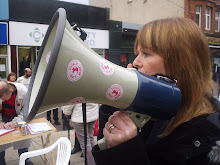
On the 13th October, 2011 at 4.13pm it will be five years since the collapse of Farepak Food & Gifts Limited.
Tens of thousands of people had their savings stolen resulting in approx £38 million being owned to Farepak Victims.
What has happened since the collapse:
BDO Stoy Hayward - On the 13th October 2006 were appointed Joint Liquidators. The last accounts given in 2010 stated that payments made totalled £4,489.716.
Included in this total is £822,445 for Liquidator's Fees; £9,050 for taxation work and £1,450,384 for forensic work.
www.farepak.co.uk/2010CreditorsReport.pdf
In April 2008 BDO initiated proceedings against the Directors to try to recover further monies that were owed to the Farepak Victims. A settlement with no admission of liability was reached with the Directors. An amount of £4 million (inclusive of costs) has been received by BDO. The terms of the settlement are confidential and the Liquidation Committee and the Joint Liquidators cannot say anthing else about this.
On 21st September 2009 cheques are sent out to 5,900 Farepak Victims who had payed monies into Farepak Food & Gifts Limited bank account after the 13th October, 2006. They are still owed monies payed in before the date of liquidation.
It is estimated that the Farepak Victims will receive 15p in the £ but BDO are unable to confirm when these payments will be made.
2011 Report to the Creditors is yet to be published.
The Directors - February 2011 the Government's Insolvency Service applied to the High Court to disqualify all nine former directors of Farepak and its parent company.
One of these Directors is Sir Clive Thompson who currently is Deputy Chairman of Strategic Equity Capital with £3,030,000 in Ordinary Shares.
If the High Court action is won and Thompson is disqualified (could take 2 years) the question is will he really be all that concerned? He has had 5 years to increase his vast wealth.
www.strategicequitycapital.com/secapital/en/home
FAREPAK VICTIMS - December 2006 the Farepak Response Fund issues vouchers worth around 15p for every £ lost.
October 2011 116,413 Farepak Victims are still owed £36.9 million.
The unfairness of this situation is very apparent – When will there be justice for the Farepak Victims?
To continue the fight for justice the Farepak Victims Committee has lodged a Government e-petition which currently is being look at by HM Treasury.
epetitions.direct.gov.uk/petitions/18820
6.11.11

The views of a British Tax expert.
There's a sickening dimension to today's agreement between the UK and Switzerland that is getting to let thousands of wealthy tax criminals off the hook – without them ever being held to account or even having to admit to their crimes.
At the moment the UK government is turning this deliberate blind eye to massive, large scale, organised looting of the UK's tax system it is also bringing criminal charges against more than thirty young people who recently took part in a in a wholly peaceful UK Uncut demonstration against tax avoidance.
They are facing criminal charges in the UK for having leaflets condemning tax avoiders when at exactly the same time the government was negotiating a deal to make sure that tax criminals were let off without ever facing the consequences of their crime.
This is a sickening indictment of the UK criminal justice system, our respect for free speech, the values of this government and the fact that we live in a society where it is now a crime to criticise the criminality that did and does pervade much of the financial services sector that deliberately promotes tax havens to facilitate crime of the sort which those using Switzerland have just been excused of.
No wonder people are angry. They have every right to be. We are being led by moral cowards who excuse crime whilst prosecuting those who exercise the supposed human right of free speech to criticise those facilitating it. It's Cameron and Osborne who should be in the dock, not the Fortnum and Mason's protesters from UK Uncut.
15.4.11
SLP Policies - Scottish Election
The Socialist Labour Party was founded to fight for socialism. Unlike New Labour, SNP, Tories and Lib Dems in this election, Socialist Labour understands that: "It is capitalism, not the complexion of governments, which is responsible for the economic and social devastation which results in: the destruction of basic manufacturing industries, mass unemployment, homelessness, helplessness and despair. Only by dealing with the root cause - capitalism itself, can this devastation be stopped and a long term alternative be constructed." -Arthur Scargill, SLP Leader. Socialist Labour's programme: EMPLOYMENT FOR ALL. The scourge of unemployment can be tackled but only with radical policies: a four day week without loss of pay. a ban on all non-essential overtime. voluntary retirement at 55 on full pay. INDUSTRY. To deal with the immediate economic and social crisis we propose: regeneration of our manufacturing and production capacity. re-opening deep mined coal, engineering and shipbuilding works. rebuilding all industries that generate real wealth and opportunities for Scotland's battered communities. investment in renewable energy industries. ENVIRONMENT. Environmental concerns must go hand in hand with resurrecting our industry: an immediate end to the madness of nuclear power stations. clean coal technology with carbon capture and an end to open cast mining. development of renewable energy resources. HEALTH & SOCIAL SERVICES. Rebuilding and further development of our NHS and social services will be a high priority for Socialist Labour: universal access to free health and social services the right to health and social services enshrined in law. the abolition of private health schemes - no one should get rich from the suffering of others - private health care also undermines our NHS. HOUSING. To tackle the housing crisis and provide work for thousands of unemployed building workers: the building of thousands of new homes each year for the duration of the next Scottish Parliament. all empty properties to be identified, modernised and converted into homes. POVERTY. Recent surveys have told us that one third of children live in poverty. This is a national disgrace, we propose: the introduction of a national minimum wage based on two thirds median male earnings. no taxation on income below £15,000. the doubling of state pensions coupled with their linking to wages and the cost of living. EDUCATION. Our comprehensive, further and higher education system is under attack and faced with deep cuts from those in government who have benefitted from a free system in the past: free, high quality education for all. free access to lifelong education. abolition of the class privilege of private education. restoration of mandatory student grants and state benefits linked to minimum wage levels. PEACE. Socialist Labour is against war. This country has got involved in many wars that are not in the interests of the Scottish people and has caused death, misery and destruction across the world. We would campaign to end current wars, to bring troops home and oppose future wars of conquest and aggression on sovereign countries. We would: remove the Trident nuclear system from the Clyde and support unilateral nuclear disarmament. withdraw this country from the aggressive NATO military alliance. oppose the concept of a "European" army oppose the arms trade. INTERNATIONALISM. With today's world racked by unjust wars, we oppose all of Britain's racist asylum and immigration laws which condemn people seeking refuge to detention, imprisonment, torture or death. The Socialist Labour Party is committed to fighting racism and fascism wherever they occur. We would: oppose the illegal and unjust sanctions upon the Cuban people. support FAIR trade and oppose "free" trade policies imposed upon impoverished nations. develop international links with peace and environmental movements, trades union organisations and womens' movements. Socialist Labour has detailed policies on these and other issues - see www.socialist-labour-party.org.uk for full details.
OUR DEMANDS MOST MODERATE ARE - WE ONLY WANT THE EARTH
VOTE SOCIALIST LABOUR PARTY ON THE 5TH MAY
On 5th May we ask you to vote for the Socialist Labour Party with your second or regional vote.
Why?
Because the SLP is committed to fighting for full employment, a free NHS and education system, a housing programme which guarantees everyone a home and the restoration of fairness in the workplace by repealing anti-Trades Union laws.
The SLP wants to see a socialist Scotland. We do not see the point in gaining autonomy for Scotland simply to give it away to the unelected and unaccountable European Union. EU bureaucrats in Brussels deny the Scottish Parliament the right to introduce common ownership and the rebuilding of industry, large and small, that has been butchered by the indifference of consecutive governments of ALL the main parties. The SLP is the only party campaigning to get Scotland out of the clutches of the EU.
The regional vote allows smaller parties the chance to gain enough support to get MSP's elected with as little as 5% of the vote. Socialist Labour MSP's in Holyrood will fight the coming deep cuts that will be imposed no matter which "main" party or coalition of parties forms the next Scottish government. We will work with local communities to campaign for more, not less, resources and services that are so essential to the life and soul of communities throughout Scotland.
Vote Socialist Labour Party - Regional Vote
18.12.10
Kosovo and the myth of liberal intervention
by Neil Clark
15th December 2010.
'The United States of America and the Kosovo Liberation Army stand for the same human values and principles ... Fighting for the KLA is fighting for human rights and American values." So declared the neocon US senator (and current foe of WikiLeaks) Joseph Lieberman back in 1999 at the height of the US-led military intervention against Slobodan Milosevic's Yugoslavia.
It would be interesting to hear what Senator Lieberman makes of the report of the Council of Europe – Europe's premier human rights watchdog – on his favourite band of freedom fighters. The report, which cites FBI and other intelligence sources, details horrific rights abuses it claims have been carried out by the KLA, the west's allies in the war against Yugoslavia 11 years ago.
The council claims that civilians – Serbian and non-KLA-supporting Kosovan Albanians detained by the KLA in the 1999 hostilities – were shot in northern Albania and their kidneys extracted and sold on the black market. It names Hashim Thaçi, the former leader of the KLA and Kosovo's prime minister, as the boss of a "mafia-like" group engaged in criminal activity – including heroin trading – since before the 1999 war. The report is a damning indictment not only of the KLA but also of western policy. And it also gives lie to the fiction that Nato's war with Yugoslavia was, in Tony Blair's words, "a battle between good and evil; between civilisation and barbarity; between democracy and dictatorship".
It was a fiction many on the liberal left bought into. In 1999 Blair was seen not as a duplicitous warmonger in hock to the US but as an ethical leader taking a stand against ethnic cleansing. But if the west had wanted to act morally in the Balkans and to protect the people in Kosovo there were solutions other than war with the Serbs, and options other than backing the KLA – the most violent group in Kosovan politics. They could have backed genuine multi-party negotiations, or offered to lift sanctions on Belgrade if a peaceful solution to the problem of Kosovo could be found.
Instead, a virulently anti-Serb stance led the west into taking ever more extreme positions, and siding with an organisation which even Robert Gelbard, President Clinton's special envoy to Kosovo, described as "without any question, a terrorist group". In 2000 the Sunday Times revealed that, prior to the Nato bombing, US agents had been training the KLA. Shaban Shala, a KLA commander, claimed he had met British and US agents in north Albania in 1996.
It was the KLA's campaign of violence against Yugoslav state officials, Serbian and Kosovan civilians in 1998, which led to an escalation of the conflict with the government in Belgrade, with atrocities committed on both sides. We were told the outbreak of war in March 1999 with Nato was the Serbian government's fault, yet Lord Gilbert, the UK defence minister, admitted "the terms put to Miloševic at Rambouillet [the international conference preceding the war] were absolutely intolerable … it was quite deliberate".
The subsequent 78-day "humanitarian" bombardment of federal Yugoslavia massively intensified the ethnic cleansing of Kosovan Albanians by Yugoslav forces. Between 2,000 and 10,000 Kosovan Albanians were killed by these forces, with between 500 and 1,500 people killed by the Nato bombing.
But even after Russian pressure forced a Yugoslav withdrawal from Kosovo, ethnic cleansing and rights abuses in the region continued. Under the Nato occupation an estimated 200,000 ethnic Serbs, Roma and other minorities from south Kosovo, and almost the whole Serb population of Pristina, have been forced from their homes.
A report on Kosovo by Minority Rights Group International claimed: "Nowhere [in Europe] is there such a level of fear for so many minorities that they will be harassed or attacked, simply for who they are." And in October 2010, a report by Human Rights Watch stated that "Roma and related minority groups deported from western Europe to Kosovo face discrimination and severe deprivation amounting to human rights abuse". As for democratic advances, Sunday's elections in Kosovo, boycotted by the Serbian minority, have seen widespread allegations of fraud, with a turnout of 149% reported in one area.
Far from being Tony Blair's "good war", Nato's assault on Yugoslavia was in its own way as immoral as the assault on Iraq. But as the Iraq war has become discredited, so it is even more important for the supporters of "liberal interventionism" to promote the line that Kosovo was in some way a success. The Council of Europe's report on the KLA's crimes makes that position much harder to maintain. And if it plays its part in making people more sceptical about any future western "liberal interventions", it is to be warmly welcomed.
5.12.10
Ireland and the European Union: Who is to blame?
by Timothy Bancroft-Hinchey,
Pravda.Ru
21.11.2010
Like a house of cards, one by one, the European Union starts to collapse. First Greece, then Ireland, next who knows? The "experts" blame the banks, blame the bankers, blame the financiers...but who is apportioning the blame to where it really lies: to the system itself?
It is by now patently obvious that no system is perfect. The Communist system in which the State provides security for its citizens, where everyone contributes towards the common good, was implemented in many countries in the twentieth century where in general terms it was hugely successful. The capitalist system, one whose vision is a society in which people are free to create their own business and stimulate the economy by creating wealth and jobs, while paying taxes to create a social umbrella, operating alongside Trade Union movements which protected workers' rights was a nice idea and on paper a good ideal.
The problem is, one system worked and the other did not. In the Communist countries, healthcare was excellent and free, schooling was excellent, and free; having a house and a job was a birthright; public transportation was free, public utilities were free; basic foodstuffs were free and distributed by the State, which in turn provided national security with strong, defensively-oriented armed forces and security on the streets - people were free to walk around without being attacked by marauding gangs of drug addicts, inner cities were free of feral children.
The other side of the Iron Curtain spent trillions of dollars trying to sabotage the model, trying to assassinate the political leaders of Communist countries (such as Fidel Castro) and from day one in Russia started interfering (the Civil War). This side of the Curtain was happy to call Stalin Uncle Joe when 26 million Soviet citizens were losing their lives defeating Hitler (90% of the Wehrmacht casualties were sustained on the Eastern Front) yet after the Great Patriotic War finished, settled back into its customary policy of antagonism against a political and social system which freed millions from the tyranny of Imperialism across the globe and brought impoverished and backward societies into the front line of development in just a few decades.
Instead of siding with and working towards the success of this system, this side of the Curtain sabotaged it and by a skilful policy of dangling carrots in front of the noses of a generation of donkeys which blindly took the bait, sent the entire world, just two decades later, into the worst economic and financial crisis it has known. And it isn't over yet. Make no mistake: the economic black hole is so vast in certain countries that there is no sunshine on the horizon and there will not be for decades to come.
And what has this wonderful capitalist system done? For a start, it turned against the attractive ideals which underpinned its basic policy, that of creating societies free to reap the reward of personal endeavour. Predictably, it has turned into a system whereby dog eats dog. Where are the high street grocery stores? They have gone, sucked into horrific black holes called hypermarkets or big spaces, where all your movements are controlled from the minute you enter to the second you leave, by the use of aromas (bread, makes you buy), the strategic placing of goods, leading you to go past the products you would not normally buy as you make for the staple goods, by manipulation of music to make you walk faster or slower, right up until the check-out, where the impulse buys are placed at just the right height to catch the attention of the average baby sitting on a supermarket trolley or the average toddler walking beside mother.
While the Communist system distributed houses for free, the other side of the Curtain turned people's lives into a nightmare from the moment they are born to the second they give up and die, no doubt being asked if they know how much money they are costing the National Health Service days before they do (as was the case with a close family member). After twelve years of education, it seems many cannot even write, higher education has become a business, as has healthcare, leisure time activities and transportation. Getting and retaining a job is a drama, buying and maintaining a house another, while a decent pension is a thing of the past. This, while bottom-line policies dictate how few police there are on the beat as the citizens grapple with living in societies in which an old lady does not feel safe to go out after dark.
Wonderful. However, that is just the start of it. As if the system itself were not bad enough, they brought in international mechanisms of control which directly affect the lives of citizens the other side of the world and in the EU, they exported it and imposed it on an inter-continental scale, in a top-down attitude of "do as I say and shut up", repeating referenda in countries whose populations obviously did not want to live in a Federal State. Take Ireland as a prime example.
And here we reach the crux of the matter: the globalization of stupidity. As if it were not enough for the "system" to turn its back on its founding principles, which were valid, it invented vectors by which rating agencies such as Fitch, Standard and Poor and Moody's (based in the USA, where else?) can stipulate how much a country's capital is worth and thereby directly affect the lives of its citizens. This has nothing to do with a system in which citizens are free to create wealth and therefore let's not call it Capitalism any more. It has morphed into something far, far worse: The speculative system.
In a word, gambling. Whereas in the past money was based upon value, i.e. trading in sea shells or the value of a silver coin (which was in Medieval times cut in half or quarters to provide the real value of a payment) speculation took its first uneasy steps when the promissory note became the currency in circulation, not worth the paper it was printed on, but having the value of the promise to pay the bearer a certain amount of money (e.g. one pound). The stake into the heart of the money-based-on-value system was the decision by the Nixon Government to unilaterally end the policy of fixing the value of the dollar to gold in 1971, destroying the Bretton Woods agreement to peg exchange rates among currencies.
The second step was the insurance market, tying monetary sums to eventualities and as time went on, these products became more and more complex, drawing in the banking system itself, insurance and reinsurance policies, investment funds, pension funds, municipalities, University funds, healthcare authorities' trusts, basing their wealth on future products of commodities, shares, government bonds, taking out insurance policies on these values...and when the public confidence in the economy collapsed, all of these products lost value because they were never based on anything tangible, purely on speculative and intangible waves of euphoria.
Nobody knows exactly how many trillions were vaporised because the knock-on effects are still being felt. It was this catastrophic backdrop which the banks were facing, their investment funds intrinsically tied up in this fog of ratings agencies and a more and more globalised economy: a world-wide house of cards waiting for a hurricane.
This system was bound to be wide open to the effects of its endemic and chronic vector of failure to create employment, where a 4% unemployment rate is classified as "healthy" (creating an underclass from the outset) and by now based upon the power of the USD, was wide open to the effects of the USA manipulating the value of the dollar to stimulate exports and to reduce its debt.
With the banks up to their ears in catastrophic investments and with unemployment rising, it came as no surprise that the system itself had positioned itself on thin ice. In Ireland's case, the budget deficit had reached 32% of its GDP, while the European Union had stipulated in its Convergence package that economies could only have a 3% deficit.
How Ireland gets back from the brink without seriously harming its consumers, who after all have fulfilled all the demands made of them, paying their taxes and following the laws imposed upon them, is a telling question for today's globalised world.
Suffice it to say that were the intelligent powers that be to raise just a one per cent tax on financial derivatives traded, hundreds of billions of USD would become readily available, taking the burden away from the citizens. This will never happen, because this system is controlled by a handful who have become super-rich at the expense of the rest of the population, consigned over time to becoming members of a global under-class.
Ladies and gentlemen, we have allowed ourselves to be duped by a global system controlled by the few, catering to their interests and rendering the endeavour of billions of people meaningless. It is as if a cabal of gamblers has taken over the world.
And guess who gets to pay their debts?
Ends.
9.11.10
STEALING HAITI'S FUTURE !
What exactly are 20,000 USA troops doing there?
Is it a pretext of Humanitarian Aid!
by Steve Whatham (Lawyer and member of The Socialist Labour Party).
I watched a news item from Haiti on the evening news, 4th November. It showed Haitians surviving in make shift crude shelters following the earthquake which occurred quite a long time ago on January 12th 2010. Very little appeared to have been carried out to provide proper shelters.
My thought drifted back to reports that International help was flooding into this impoverished country. I was aware already that Cuban doctors in great numbers had already been working in Haiti for a number of years and had set up clinics where sick people could get medical help at no cost.
News reports stated that the United States had sent in Navy ships and up to 20,000 troops. My, what you can do with this amount of help if sent for the purpose of helping the people.
Assuming this huge deployment was to help the afflicted but not trusting the intentions of the Americans with their record of interventions throughout the world I surfed the web and obtained the following assertions.
Writing for “Global Research Articles”, Marguerite Laurent states the following which I have shortened but not altered the information.
"After being called crazy and un-American for writing that the 2010 earthquake gives the US the perfect disaster-capitalism opportunity to come out from behind the UN and openly occupy Haiti to secure Haiti's oil, strategic location and other riches for the corporatocracy...
The Greater Antilles, which includes Cuba, Haiti, the Dominican Republic, Puerto Rico and their offshore waters, probably hold at least 142 million barrels of oil and 159 billion cubic feet of gas, according to a 2000 report by the U.S. Geological Survey. Undiscovered amounts may be as high as 941 million barrels of oil and 1.2 trillion cubic feet of gas, according to the report. Among nations in the northern Caribbean, Cuba and Jamaica have awarded offshore leases for oil and gas development. Trinidad and Tobago, South American islands off the coast of Venezuela, account for most Caribbean oil production, according to the U.S. Energy Department.
I've been writing for years now that the US has been trying to get rid of Haiti's democratically elected government since 1991 so they could get to "their" strategic reserves without any fear of a populous president nationalizing the oil and gas reserves to benefit the miserably poor majority in Haiti as has been done in Venezuela or elsewhere in Latin America. (See, Haiti is full of oil, say Ginette and Daniel Mathurin, where these scientist say there's more oil in Haiti than in Venezuela.) No one has been listening. Not even the white liberals who are such defenders of Haiti. To the best of my knowledge, other than Haitians, over the long years before the earthquake, the only non-Haitian observers who ever paid attention and picked up on our reports and concerns about the plundering and pillaging of Haiti's riches, were John Maxwell and Chris Scott of CKUT Radio in Canada. That's it. All the others bought the State Department line that Haiti was a charity case and had no resources to mention.
Today Haiti has oil and 20,000 troops are down there to secure it and Haiti's other riches while the vision is to perhaps herd the displaced earthquake victims - who don't die from their TV-aid - into hastily constructed pre-fabricated houses and let the ghettos fester as they do in Kingston, Jamaica, while the areas the whites and Haitian oligarchy want are developed into tourist havens and all capital is flown out of Haiti.
There exists a “Lavalas map” of Haiti's resources which shows that Kafou's Morne Cabrit the area affected by the quake housed a huge reserve of oil. Here's the article I wrote, last year documenting that Haiti had oil and that was the reason for the US/UN forced removal of President Jean Bertrand Aristide. I do so hope, this time, to honour the lives lost and really help protect the remaining survivors of Bush the first and Bush the lesser's two regimes changes in Haiti and now this total occupation, that conscious Americans and all decent folks on this earth, are paying attention and will help us stop this latest travesty.
The just thing for now, is to allow former President Aristide who was kidnapped out of Haiti on a rendition plane by the US Special forces and has been practically under house arrest in South Africa for 6-years, forbidden first by US Secretary of State Condi Rice and now Hillary Clinton from returning home, to return to his country. He ought to be returned to Haiti so he may assist Haiti’s majority at this agonizing time and help in the relief and rebuilding of the nation".
A further article dated October 15th on Axis of Logic by a columnist called Dady Chery was headed:- Hatians Demand UN to take its colonial Army, MINUSTAH Out and said:-
"It is high time to bid good riddance to MINUSTAH (MIssion des Nations Unies pour la Stabilisation en Haďti), a colonialist army that has terrorized Haiti for the last six years and is currently overseeing the sham presidential and legislative elections in the country.
The most popular political party, Lavalas, is being excluded from the elections. MINUSTAH’s 1994 appearance came on the heels of Aristide’s transport into exile after he decreed a minimum-wage increase. Brazil, Canada, and the United States, all countries with powerful interests in Haitian sweatshop labour, are the key supporters of this army, which consumes more than one fourth of Haiti’s state budget.
Haitians -- rich and poor, and throughout the political spectrum -- despise MINUSTAH. Its horrors range from the daily confiscations of drivers licenses and computers, to well-documented cases of rape and murder.
Even so, year after year, the UN Security Council renews MINUSTAH’s mandate. Such renewals typically follow several weeks of insecurity so predictable one could set one’s watch to it. This year is one year too many. Throughout the critical first 72 hours after the January 12th earthquake, cowardly MINUSTAH soldiers scrambled to rescue their own personnel and left the Haitian earthquake victims to themselves.
On October 15, 2010, MINUSTAH’s mandate expires. Perhaps readers can offer some other reason for the deployment of the 20,000 American soldiers?"
The full article by Marguerite Laurent and Ezili Danto is on the web and gives possible reasons for what triggered the earth quake which for some reason was in the area where oil is said to be present and did not go as far as the border with the Dominican Republic.
5.11.10
The Welfare State
As the Second World War drew to a close discontented British troops and workers were determined not to return to the conditions of the 1930s.
As author John Gorman emphasised in his work ‘To Build Jerusalem’ -
“For the labour movement the war strengthened the commitment of ‘no return to the thirties’. After the experience of fighting from Dunkirk to Berlin, and in deserts and jungles, there was a resolve to refuse to return to a Britain of class privilege, private wealth and public squalor”.
The government’s response to this unrest was the Beveridge Report, also known as ‘Social Insurance and Allied Services’, published in 1942, which formed the basis for establishing the Welfare State and National Health Service after WW2.
The Report claimed “It is, first and foremost, a plan of insurance - of giving in return for contributions benefits up to subsistence level, as of right and without means test, so that individuals may build freely upon it.”
To this end the report’s principle proposed change was “Unification of social insurance in respect of contributions, that is to say, enabling each insured person to obtain all benefits by a single weekly contribution on a single document.”
(Above quotations from the Beveridge Report November 1942).
This weekly National Insurance contribution would serve as access to benefits such as free health care, unemployment pay and a State pension upon retirement and thereby a comprehensive system covering people ‘from cradle to grave’.
By any objective assessment this was an historic gain for the population of Britain.
The Beveridge report was at the time a culmination of the welfare policies that had been adopted previously. The report acknowledges for example, the Poor Law, the Workmen’s Compensation Act 1897, the Pensions Act passed in 1908, the Unemployment Act of 1934.
This move for more State intervention in welfare and social policy grew during the Second World War; free school milk and meals were introduced for example, and apart from initiating the Beveridge Report the government introduced white papers on education and a national health service. These developments materialised in the Education Act of 1944 which provided free secondary education for all and in the reforms introduced by the Clement Attlee led Labour government after the war, with the passing of the National Insurance Act and the NHS Act.
Since the 1980s we have seen successive governments attempt to roll back these historic gains, culminating today in the attempt by the current coalition government to end welfare and social provision completely.
Trade unions, which represent millions of workers, must not only secure the interests of workers at their place of employment but must see it as their duty to also protect and defend all the past gains, made at great sacrifice, by our ancestors.
Ends.
16.10.10
The Chilean abuses kept in the shadows
by John Pilger
The rescue of 33 miners in Chile is an extraordinary drama filled with pathos and heroism. It is also a media windfall for the Chilean government, whose every beneficence is recorded by a forest of cameras. One cannot fail to be impressed. However, like all great media events, it is a facade.
The accident that trapped the miners is not unusual in Chile, but the inevitable consequence of a ruthless economic system that has barely changed since the dictatorship of General Augusto Pinochet.
Copper is Chile's gold, and the frequency of mining disasters keeps pace with prices and profits. There are, on average, 39 fatal accidents every year in Chile's privatised mines. The San Jose mine, where the men work, became so unsafe in 2007 that it had to be closed - but not for long.
On July 30 last, a Labour Department report warned again of "serious safety deficiencies," but no action was taken. Six days later, the men were entombed.
For all the media circus at the rescue site, contemporary Chile is a country of the unspoken.
At Villa Grimaldi, in the suburbs of the capital Santiago, a sign says: "The forgotten past is full of memory."
This was the torture centre where hundreds of people were murdered and disappeared for opposing the fascism that Pinochet and his business allies brought to Chile.
Its ghostly presence is overseen by the beautiful Andes, and the man who unlocks the gate used to live nearby and remembers the screams.
I was taken there one wintry morning in 2006 by Sara de Witt, who was imprisoned as a student activist and now lives in London. She was electrocuted and beaten, yet survived.
Later, we drove to the home of Salvador Allende, the great democrat and reformer who perished when Pinochet seized power on September 11 1973 - Latin America's own 9/11. His house is a silent white building without a sign or a plaque.
Everywhere, it seems, Allende's name has been eliminated. Only on the lone memorial in the cemetery are the words engraved, "Presidente de la Republica," as part of a remembrance of the "ejecutados politicos" - those "executed for political reasons."
Allende died by his own hand as Pinochet bombed the presidential palace with British planes and the US ambassador watched.
Chile is now a democracy, though many would dispute that. In 1990, Pinochet bequeathed a constitutionally compromised system as a condition of his retirement and the military's withdrawal to the political shadows.
This ensures that the alliance of broadly reformist parties, known as the Concertacion, is permanently divided or drawn into legitimising the economic designs of the dictator's heirs.
At the last election the right-wing Coalition for Change, the creation of Pinochet's ideologue Jaime Guzman, took power under President Sebastian Pinera.
The bloody extinction of true democracy that began with Allende's death was, by stealth, made complete.
Pinera is a billionaire who controls a slice of the mining, energy and retail industries. He made his fortune in the aftermath of Pinochet's coup and during the free-market "experiments" of the zealots from the University of Chicago, known as the Chicago Boys.
His brother and former business partner Jose Pinera, a labour minister under Pinochet, privatised mining and state pensions and all but destroyed the trade unions.
This was applauded in Washington as an "economic miracle," a model of the new cult of neoliberalism that would sweep the continent and ensure control from the north.
Today Chile is critical to President Barack Obama's rollback of the independent democracies in Ecuador, Bolivia and Venezuela.
Pinera's closest ally is Washington's main man, Juan Manuel Santos, the new president of Colombia, home to seven US bases and an infamous human rights record familiar to Chileans who suffered under Pinochet's terror.
Post-Pinochet Chile has kept its own enduring abuses in the shadows. Families still attempting to recover from the torture or disappearance of a loved one bear the prejudice of the state and employers.
Those not silent are the Mapuche people, the only indigenous nation the Spanish conquistadors could not defeat.
In the late 19th century, the European settlers of independent Chile waged a racist war of extermination against the Mapuche, who were left as impoverished outsiders. During Allende's thousand days in power, some Mapuche lands were returned and a debt of justice was recognised.
Since then, a vicious and largely unreported war has been waged against the Mapuche. Forestry corporations have been allowed to take their land, and their resistance has been met with murders, disappearances and arbitrary prosecutions under "anti-terrorism" laws enacted by the dictatorship.
In their campaigns of civil disobedience, none of the Mapuche has harmed anyone.
The mere accusation of a landowner or businessman that the Mapuche "might" trespass on their own ancestral lands is often enough for the police to charge them with offences that lead to Kafkaesque trials, with faceless witnesses and prison sentences of up to 20 years.
They are, in effect, political prisoners.
As the world rejoices at the spectacle of the miners' rescue, 38 Mapuche hunger strikers have not been news.
They are demanding an end to the Pinochet laws used against them, such as "terrorist arson," and the justice of a real democracy. On October 9, all but one of the hunger strikers ended their protest after 90 days without food.
A young man, Luis Marileo, says he will go on. On October 18, President Pinera is due to give a lecture on "current events" at the London School of Economics.
He should be reminded of their ordeal and why.
This article appeared in the New Statesman.
14.9.10
Arthur Scargill Speech
Arthur Scargill, legendary leader of the National Union of Mineworkers during the Great Strike of 1984/85, spoke at a Socialist Labour Party public meeting in Barnsley on 6th September 2010. This is a recording of the speech and it makes excellent listening.
Working class people are under attack, our jobs, our wages and conditions, our pensions, our public services fought for over generations are all threatened. Youth unemployment is rising at an astronomical rate on top of an already record level while at the same time education opportunities are being cut...
It's time to fight back! It's time to stand up for the socialist society - the only viable long term alternative to a decaying capitalist system.
27.8.10
Chile's trapped miners
Even those who have done the dangerous work of mining can only imagine what the 33 men are going through in Chile
By Ken Capstick (NUM & SLP)
Guardian 25th August 2010.
The 33 miners trapped below ground in Chile’s San José mine since 5 August are suffering the worst nightmare of miners the world over, who will be sharing their pain and that of their families, desperately hoping the rescuers succeed.
I spent 38 years of my life working as a coalminer and many long hours underground. I will never forget leaving school and jumping for joy – we said it was “the end of bondage”. I was 15, it was Easter 1956. Normally we would get a week’s holiday – I got two days and then found myself feeling imprisoned in what seemed worse than any dungeon. Deafening noise, constantly moving machinery, little light with which to see, grimy surroundings and hard physical work was my lot in life.
I was out of bed by 4.30 in the morning, trudging to the pit with my father; weather conditions, however bad, never stopped him or most miners. Men would crush on to the cage, as it was known, and then there would be a sudden plunge into the shaft as it hurtled for almost half a mile into the depths of the Earth. The bricks of the shaft wall were just a blur – four Blackpool towers end-on-end would just about reach from top to bottom.
I would start work at 6am and work until 1.30pm. Looking back now I realise how dangerous it was. At the end of the shift I would wash in the pithead baths and catch the bus in the pit yard, known as the pit paddy, which circled the mining village and dropped everyone off near their homes. Mother had the dinner on the table. I often fell asleep eating it.
I finished my first five days, Monday to Friday, in what seemed like a year. Saturday was voluntary in those days. I told my father I wasn’t going. He told me I was.
There was constant danger, and supervision by older miners was essential. They took care of you, but not in a mollycoddling sort of way – it was rough justice if you didn’t do as you were told, back-chatted or got “too big for your boots”.
I became an electrician and worked in every part of the mine. It was regarded by other miners as a cushy number. It was, but only by comparison with the work they did. Conditions were often cramped, crawling on hands and knees, breathing foul air, coughing and spitting out black coal dust from deep in your lungs.
Miners didn’t suffer fools gladly: coalmining was harsh. Conditions could be freezing cold or boiling hot in different parts of the same mine. Miners worked often on their bellies, using a pick and shovel all day, doing crushingly hard work. They ended up with bronchitis and emphysema, industrial deafness, broken limbs, dust on the lungs and were called greedy by people who could never understand. And we have had our share of disasters that have killed hundreds of miners in the time it takes to say, “Look out”. Sometimes they would be torn to bits after being dragged into brutal machinery, quite literally carried out in bags like chunks of mincemeat. It would be announced in passing on the news.
I once helped to carry a friend out of the mine. He was dead. He had been buried by a large fall of ground. We worked feverishly to get him out. That was 40 years ago. I laid a wreath at the altar in memory of him recently. It never goes away.
Eight miners have died in Britain’s coalmines in the past four years.
www.bbc.co.uk/bradford/sense_of_place/lofthouse_colliery_disaster.shtmlan inrush of water killed seven. Their comrades worked for a solid fortnight before being forced to leave them buried where they died.
Miners depend on each other for their own safety, which creates an unbreakable bond of camaraderie. Some might find it strange that a coalmine echoes to the sound of laughter. If I miss anything, it is the humour.
A miner is a miner wherever he works. Sometimes I spent 18 hours at a stretch in a coalmine, but can only imagine what it must be like for those fellow miners trapped in the unimaginable darkness of the San José gold and copper mine.
Leadership will be a vital element, someone experienced who they trust and respect, with the authority and mental strength to maintain his own morale as well as that of the others. I have met many men of that calibre. And in San José, 670 metres underground, it seems a natural leader has emerged – 54-year-old shift foreman Luis Urzúa.
If you have ever called a miner greedy, say a prayer with me tonight for those in Chile who, if reports are accurate, look like being there until Christmas.
Ends
3.5.10
The Case for Clean Coal
Ken Capstick, former Vice President of Yorkshire National Union of Mineworkers gives a speech on British and world energy issues and makes the case for the use of Clean Coal utilising Carbon Capture and Storage as an integral part of an Integrated Energy Policy for Britain.
Essential listening for anyone concerned for future energy provision and a world that tackles CO2 emissions in the only practical way available.
Ayrshire, Scotland.
May 2010
5.9.09
Lockerbie – the Truth
Abdel Basset al-Megrahi and the Elephant in the Room.
Comment by Dave Roberts SLP vice-president
The press and media are full of hysteria over the release of the convicted “Lockerbie bomber”. The moralising outrage stretches across the Atlantic. The Scottish Justice minister is being slated for going soft on terrorism by senior FBI officials, the SNP and Scotland are being threatened with international isolation and even pariah status. Mandelson, Brown, Blair and Straw are being accused of doing a grubby back room deal with the Libyans for oil contracts in exchange for the release of the “greatest murderer” in British History.
To add to their squirming misery Saif Gaddafi, Colonel Gaddafi’s second son has confirmed to the world’s media that al- Megrahi’s release has been on the table of every oil trade negotiation meeting during the last two years.
So has the Scottish and British establishment completely lost the plot and are they going soft on terrorism? Is the frantic scramble for oil now so paramount that it threatens a British rift with the US establishment?
In the smoke and mirrors of what passes for international diplomacy what is actually going on?
The answer is simple, if not even more troublesome for the British and American establishments and many of their media sycophants who insisted throughout the Lockerbie case in elevating their journalism to the dizzy heights of the gutter.
The enormous elephant in the room that at the moment everyone is painfully trying to ignore is that al Megrahi is an innocent man and in that sense yet another victim of the Lockerbie bombing and the whole world was about to be told it and shown it.
Terminally ill he was given the opportunity of release on compassionate grounds in return for dropping his appeal. An appeal that would have proved that he was innocent, that he was fitted up by the British and American Governments in what Professor Robert Black (the lawyer responsible for brokering the deal for the two accused of the bombing to stand trial in the Netherlands under Scottish law) describes as one of the greatest travesties of justice in the history of the Scottish Judicial System.
An appeal that was welcomed by Dr Jim Swire .who lost his 28 year old daughter Flora in the bombing and who represents many of the families of the British victims because he knows al-Megrahi to be innocent, an appeal that would have shown that it was the British and American governments that engaged in a grubby deal with Syria and Iran to keep them out of Gulf War1 by lifting arms and trade sanctions and dropping the investigation into their involvement in the Lockerbie bombings. Until that time the investigation had centred on an Iranian sponsored Syrian/Palestinian revenge attack for the mass murder of 290 Iranian pilgrims when their civilian airliner was shot down by the American aircraft carrier Vincennes.
This grubby deal was done to allow the Americans to invade Iraq without Syrian and Iranian intervention and the investigation was conveniently realigned, pointing the finger at Libya, which paved the way for the American and British to commit mass murder in Iraq.
This is the substantive truth of the case which the British and American establishment fear would surface in any appeal. A truth that many of the victims’ families are painfully aware of and now demand the evidence.
Dr Jim Swire often quotes a telling fact from Thatcher’s biography in which she triumphantly claims that since in the face of international condemnation, she agreed to join the Americans in the bombing of Tripoli Benghazi and much of costal Libya and specifically the targeting of Gaddafi’s home, a raid which left his 7 year old daughter dead, and another 280 civilians killed, “Libya had not been involved in any further attacks on western interests”.
Unfortunately for Mrs Thatcher, if the fabrication of Libyan involvement is to be believed, she seems to have forgotten that the biggest single attack on Western interests before 9/11, involving an American plane in British airspace and a death toll of 270, took place nearly 24 months after the bombing of Tripoli. Unless of course she knows something different?
It is Kafkaesque for Jack Straw, who with the rest of the Labour government has conspired to keep an innocent man in jail for 8 years whilst ensuring that the war criminal General Pinochet goes free, is titled the Minister for Justice. Some Minister, Some justice !
Open the files, for a non- redacted public enquiry now and show some real compassion and justice for all the Lockerbie victims including Abdel Basset al- Megrahi!
Ends.
18.7.09
What Economy?
The following article was forwarded to me by an American friend. It's written by the former Assistant Secretary of the Treasury in the Reagan Administration. No leftwinger then! If he's correct in his assessment it makes for scary reading.
July 16, 2009
There's Nothing Left to Recover
What Economy?
By PAUL CRAIG ROBERTS
There is no economy left to recover. The US manufacturing economy was lost to offshoring and free trade ideology. It was replaced by a mythical “New Economy.”
The “New Economy” was based on services. Its artificial life was fed by the Federal Reserve’s artificially low interest rates, which produced a real estate bubble, and by “free market” financial deregulation, which unleashed financial gangsters to new heights of debt leverage and fraudulent financial products.
The real economy was traded away for a make-believe economy. When the make-believe economy collapsed, Americans’ wealth in their real estate, pensions, and savings collapsed dramatically while their jobs disappeared.
The debt economy caused Americans to leverage their assets. They refinanced their homes and spent the equity. They maxed out numerous credit cards. They worked as many jobs as they could find. Debt expansion and multiple family incomes kept the economy going.
And now suddenly Americans can’t borrow in order to spend. They are over their heads in debt. Jobs are disappearing. America’s consumer economy, approximately 70% of GDP, is dead. Those Americans who still have jobs are saving against the prospect of job loss. Millions are homeless. Some have moved in with family and friends; others are living in tent cities.
Meanwhile the US government’s budget deficit has jumped from $455 billion in 2008 to $2,000 billion this year, with another $2,000 billion on the books for 2010. And President Obama has intensified America’s expensive war of aggression in Afghanistan and initiated a new war in Pakistan.
There is no way for these deficits to be financed except by printing money or by further collapse in stock markets that would drive people out of equity into bonds.
The US government’s budget is 50% in the red. That means half of every dollar the federal government spends must be borrowed or printed. Because of the worldwide debacle caused by Wall Street’s financial gangsterism, the world needs its own money and hasn’t $2 trillion annually to lend to Washington.
As dollars are printed, the growing supply adds to the pressure on the dollar’s role as reserve currency. Already America’s largest creditor, China, is admonishing Washington to protect China’s investment in US debt and lobbying for a new reserve currency to replace the dollar before it collapses. According to various reports, China is spending down its holdings of US dollars by acquiring gold and stocks of raw materials and energy.
The price of one ounce gold coins is $1,000 despite efforts of the US government to hold down the gold price. How high will this price jump when the rest of the world decides that the bankruptcy of “the world’s only superpower” is at hand?
And what will happen to America’s ability to import not only oil, but also the manufactured goods on which it is import-dependent?
When the over-supplied US dollar loses the reserve currency role, the US will no longer be able to pay for its massive imports of real goods and services with pieces of paper. Overnight, shortages will appear and Americans will be poorer.
Nothing in Presidents Bush and Obama’s economic policy addresses the real issues. Instead, Goldman Sachs was bailed out, more than once. As Eliot Spitzer said, the banks made a “bloody fortune” with US aid.
It was not the millions of now homeless homeowners who were bailed out. It was not the scant remains of American manufacturing--General Motors and Chrysler--that were bailed out. It was the Wall Street Banks.
According to Bloomberg.com, Goldman Sachs’ current record earnings from their free or low cost capital supplied by broke American taxpayers has led the firm to decide to boost compensation and benefits by 33 percent. On an annual basis, this comes to compensation of $773,000 per employee.
This should tell even the most dimwitted patriot who “their” government represents.
The worst of the economic crisis has not yet hit. I don’t mean the rest of the real estate crisis that is waiting in the wings. Home prices will fall further when the foreclosed properties currently held off the market are dumped. Store and office closings are adversely impacting the ability of owners of shopping malls and office buildings to make their mortgage payments. Commercial real estate loans were also securitized and turned into derivatives.
The real crisis awaits us. It is the crisis of high unemployment, of stagnant and declining real wages confronted with rising prices from the printing of money to pay the government’s bills and from the dollar’s loss of exchange value. Suddenly, Wal-Mart prices will look like Nieman Marcus prices.
Retirees dependent on state pension systems, which cannot print money, might not be paid, or might be paid with IOUs. They will not even have depreciating money with which to try to pay their bills. Desperate tax authorities will squeeze the remaining life out of the middle class.
Nothing in Obama’s economic policy is directed at saving the US dollar as reserve currency or the livelihoods of the American people. Obama’s policy, like Bush’s before him, is keyed to the enrichment of Goldman Sachs and the armament industries.
Matt Taibbi describes Goldman Sachs as “a great vampire squid wrapped around the face of humanity, relentless jamming its blood funnel into anything that smells like money.” Look at the Goldman Sachs representatives in the Clinton, Bush and Obama administrations. This bankster firm controls the economic policy of the United States.
Little wonder that Goldman Sachs has record earnings while the rest of us grow poorer by the day.
Paul Craig Roberts was Assistant Secretary of the Treasury in the Reagan administration. He is coauthor of The Tyranny of Good Intentions.
13.7.09
The Hidden Story Behind Rwanda's Tragedy
Below is a recent article by Chris Black from Canada. It deals with the background to the Rwandan tragedy and contains information not to be found in the western news coverage.
Toronto-based Christopher Black is a Barrister and International Criminal Lawyer. He is Lead Counsel for General Augustin Ndindiliyimana, Chief of Staff, Rwandan Gendarmerie before the International Criminal Tribunal For Rwanda (ICTR).
The Hidden Story Behind Rwanda's Tragedy By Christopher Black July 3rd, 2009 Rwanda before 1990 was considered the Switzerland of Africa, a model of social development.
The result of the 1959 social revolution that deposed the Tutsi monarchy and aristocracy and freed the majority Hutu population from serfdom and a lifetime of humiliation was the establishment of a collective society in which both Hutus, and Tutsis, as well as Twas, lived together in relative harmony.
Tutsis were members of the government, its administration, present in large numbers in the education system, the judiciary, and controlled most of the large private commercial companies in Rwanda.
The Rwandan army was a multiethnic army composed of both Hutus and Tutsis, and it stayed a multiethnic force even when the Rwandan Army was forced by the invaders from Uganda to retreat into the Congo forests in July 1994 because it ran out of ammunition due to the Western embargo on arms and supplies.
Rwanda descended into chaos in 1990 when the self-described Rwandan Patriotic Front (RPF) forces launched a surprise attack on October 1, 1990, from Uganda. In fact, every one of the enlisted men and officers of that invasion force were members of the Ugandan national Army. It was an invasion by Uganda disguised as an independent force of “liberation”. Liberation from what, has never been stated.
Initially the justification put out by the RPF was that of attaining the return of Tutsi “refugees” from Uganda to Rwanda. However, that problem had been resolved by an agreement between the RPF, Uganda, Rwanda, the United Nations High Commission for Refugees (UNHCR) and the OAU, a few weeks earlier.
The Rwandan government had agreed to the return of all those Tutsis in Uganda who wanted to return to Rwanda. That accord required that Tutsi representatives of the refugees travel to Kigali for a meeting to determine the mechanics of that population-movement, and how to accommodate all those people in a small country. They were expected at the end of September 1990. They never arrived. Instead of civilians returning in peace, Rwanda was viciously attacked on October 1, 1990, by a force that unleashed unbridled savagery.
During that invasion the RPF forces of the Ugandan Army slaughtered everyone in their path, Hutu or Tutsi. Tens of thousands of innocent civilians, the majority Hutu, were butchered. These crimes have never been accounted for.
The RPF’s favorite method was the bayonet or knife with which they disembowelled men and women, or to tie their hands behind their backs and smashed their skulls with hoes, the farm tool iconic of the Hutu peasantry.
After several weeks of intense fighting, the RPF forces were destroyed by the small Rwandan Army and the remnants fled, on US instructions, back into Uganda to regroup and reorganize. The RPF still never justified this aggression and the needless slaughter of civilians in a peaceful country. Individual Tutsis had always been allowed to return to Rwanda from the early 1960s and several times the Rwandan government invited them all to return. However the Tutsi aristocracy, jealous of its lost power and viewing the Hutus as merely subhuman, refused to return unless their absolute power was restored. This the people of Rwanda, even the Tutsis who remained in the country, refused.
In the 1960s and early 1970s various Tutsi groups in Uganda and elsewhere had organized terrorist raids into Rwanda in which they murdered without pity anyone they caught. These raids were repelled by Rwanda’s tiny armed forces. The years that followed were a period of development and peace for Rwandans.
Even though one of the smallest and poorest countries in the world, it had the best roads, healthcare, and education systems in Africa. Until the late 1980s, it prospered and received help from both the socialist countries, like the USSR, North Korea and China, and West Germany, France, Israel and others.
Some Tutsis in Uganda became involved in the civil wars there between the socialist Milton Obote and the US- and UK-puppet, Yoweri K. Museveni, who was supported by the West to get rid of socialism in Uganda. By 1990 Tutsis composed a large section of the Ugandan Army and all the senior officers of the RPF were high officers in the Ugandan NRA (the National Resistance Army). Paul Kagame, himself, was one of the highest-ranking officers in the intelligence services of the Ugandan army and was notorious for his enjoyment of torturing prisoners. Rwanda until 1990 was a one-party socialist state.
The ruling party, the National Movement For Revolutionary Development (MRND), was not considered a party as such, but rather a social movement in which everyone in the society took part through local elections and the mechanism of consensus, much like the system in Cuba.
The fall of the Soviet Union led to pressure from the West, notably the United States and France to dismantle the one-party state system and permit multiparty democracy. The President, Juvenal Habyarimana, instead of resisting, agreed to a change in the constitution, and, in 1991, Rwanda became a multiparty democracy. The fact the Rwandan government did this in the middle of a war is more than remarkable. It was also an offer of peace. The RPF, since its abject failure in 1990, had changed its strategy from a frontal assault to the tactics of terrorism. The RPF likes to refer to this phase as ‘the guerrilla’.
However, it was not the guerrilla of a liberation struggle like the FLMN in Vietnam or the FARC in Colombia. It was, instead, a mirror image of the Contras campaign of terrorism conducted against the Sandinistas in Nicaragua. Its purpose was not to make revolution. Its purpose was to overthrow the 1959 revolution. And, like the contras, the RPF was supported by the United States. This was clear from the beginning of the war. When the RPF launched their attack, President Juvenal Habyarimana was in Washington, lured out of the way, by the US State Department. The evidence that the US was aware of and supported the October surprise attack was the US Administration’s offer to Habyarimana of asylum in the United States if he surrendered power to the RPF. Habyarimana refused and immediately flew back home. There was no condemnation of the Ugandan-RPF aggression by the United States--a matter France raised at the United Nations--or any of its allies despite the big noise they made at the same time about the advance of Iraqi forces into Kuwait. Further, the Rwanda ambassador to the UN, then on the Security Council, filed a protest with the UNSC, but the US had it taken off the agenda.
In fact the US and its allies supported the aggression against Rwanda from its onset, and US Special Forces operated with the RPF from the beginning. Recently, while former president Bill Clinton was in Toronto, he denied any involvement in Rwanda--this is one of the Big Lies of the century. Clinton and George W. Bush are up to their necks in the blood of the Rwandan and Congolese people.
With the arrival of multiparty democracy in 1991, the RPF took full advantage and created several front parties to take away support from the popular MRND. These parties, though claiming to represent different political views, were, in fact, the main front parties for the RPF. The press was expanded and many of the new papers were financed by and acted as mouthpieces for the RPF.
At the same time as these parties sprang up, criticizing the government, the RPF continued its terror campaign: planting mines on roads that killed Hutu and Tutsi alike; assassinating politicians and officials; and blaming it, with the help of various western intelligence agency-funded NGOs, on the government. In 1992, a coalition government was formed with the RPF, with its front parties seizing control of key ministries and appointing the prime minister. Through these agents they also controlled the civilian intelligence services that they then began to dismantle. The RPF engaged in a “talk and fight” strategy. Always agreeing to a ceasefire, pressing for more power, then launching new attacks on civilians. The most egregious of these ceasefire violations was their major offensive in February 1993 in which they seized the major town of Ruhengeri, while murdering 40,000 civilians, most of them Hutu, in the process. The Rwandan Army, even though hamstrung by the civilian ministries controlled by the RPF, managed to drive the RPF back. Finally, in August 1993, under pressure from the United States and its allies, Rwanda signed the Arusha Accords, giving the RPF major concessions in return for the formation of a broad-based transition government, which was to be followed by general elections.
However, the RPF knew they could not win such elections, as they were not only unpopular with the majority Hutu population, but it did not even enjoy the support of many internal Tutsis whose lives and businesses had been destroyed by this war that they did not see a need for. Instead of preparing for elections, the RPF prepared for their final offensive. As far back as December 1993, UN reports document the massive build-up of men and weapons coming in from Uganda.
A UN force was deployed supposedly to ensure a peaceful transition; in fact, it was a cover for the US and its allies to assist in this build up. General Roméo Dallaire, the Canadian general in charge of the UN force, hid this build up from the Rwandan army and the President. The build up was accompanied by death threats against the president. According to an account of Habyarimana’s last conversation with Mobutu Sese Seko, president of what was then Zaire, just two days before the Rwandan president was murdered, Assistant U.S. Secretary of State for African Affairs Herman Cohen had, in October 1993, told Habyarimana that unless he ceded all power to the RPF they were going to kill him and drag his body through the streets. These threats were punctuated by the murder by Tutsi officers in October 1993 of the first democratically-elected Hutu president of neighboring Burundi, Melchior Ndadaye, a terrorist act in which Kagame and the RPF also had a hand; the officers who committed the murder, including Lieutenant Paul Kamana, later fled to Uganda. Ndadaye was in office a mere four months, having won the country’s first free elections. In the aftermath of that murder, 250,000 Hutus weremassacred by the Tutsi army of Burundi and hundreds of thousands of Hutus fled to Rwanda.
The result of the 1993 offensive was that one million Hutus fled the RPF terror in northern Rwanda towards the capital, Kigali, so that by April 1994, over a million refugees were encamped close to the capital and hundreds of thousands more in camps in the south, all having fled RPF terror. The RPF did all it could in 1994 to paralyze the functioning of the government, to exacerbate racial tensions, and to prepare for war. Then on April 6, 1994, they launched their final surprise attack by shooting down the Rwandan presidential plane returning from a meeting in Tanzania that had been arranged by Uganda’s president Museveni. In fact, it is known that Museveni’s half-brother, General Salim Saleh, was at the final meeting in which the date for the shoot-down was fixed. The missile attack killed Habyarimana, as well as Burundi’s new Hutu president, Cyprien Ntaryamira, and Rwanda’s military chief of staff, and everyone else on board. This was the first massacre of 1994, and it was a massacre of Hutus by the RPF.
The RPF then immediately launched attacks across Kigali and the north of the country. In the sector of Kigali known as Remera, they killed everyone on the night of the 6th and the 7th, wiped out the Gendarme camp there, wiped out the military police camp at Kami and launched a major attack against Camp Kanombe, Camp Kigali and the main gendarme camp at Kacyriu. The Rwandan government and army called for a ceasefire the same night and the next day. The RPF rejected the call. The Rwandan government asked for more UN help to control the situation. Instead, the US arranged for the main UN force to be pulled out while flying in men and supplies to the RPF in C130 Hercules aircraft.
The Rwandan Army, short on ammunition and unable to contain the RPF’s advances, even offered to surrender unconditionally on April 12th. The RPF rejected even this offer, and, instead, shelled the Nyacyonga refugee camp where one million Hutu refugees were located, provoking their flight into the capital. The effect of one million people flooding into a small city that itself was under bombardment cannot be described. The RPF used this flood of people to infiltrate its men behind Rwandan army lines. This created panic among the Hutu population, which began killing anyone they did not recognize. It was clear that the RPF was not interested in saving lives, even Tutsi lives, but only in seizing total power and did not want to negotiate at all. The late Dr. Alison Des Forges, the American who was considered a noted scholar on Rwanda, in her testimony in the Military II trial at the International Criminal Tribunal for Rwanda (ICTR) in 2006, testified that the RPF’s claim that they attacked to stop a “genocide” was a myth; just propaganda to justify their attempt to seize power by force of arms. She also testified that the Rwandan government did not plan and execute genocide. This accords with the testimony of General Dallaire, who also confirmed an earlier statement that there was no genocide planned by the government, as well as that of the deputy head of Belgian Army intelligence, Col. Vincent, who also testified at the ICTR that the idea of a genocide was a fantasy. The fighting in Kigali was intense. UN officers–confirming what has been said by Rwandan and RPF officers who have testified—state that the RPF was launching hundreds of Katyusha rockets every hour, round the clock, while the Rwandan Army ran out of hand grenades in the first few days and was reduced to fighting the RPF with hand made explosives. The vaunted RPF could not take Kigali. The siege of Kigali lasted three months and only ended when the Rwandan Army literally ran out of ammunition and ordered a general retreat into the Congo forest. RPF officers have stated that the RPF killed up to two million Hutus in those 12 weeks in a deliberate campaign to eliminate the Hutu population. The Akagera River, the full-length of which was under RPF control throughout, ran red with the blood of the Hutus massacred on its banks. The RPF claimed these were Tutsis, but there were no Tutsis in that area and only the RPF had access to it.
Robert Gersony, of the USAID, in an October 1994 report to the UNHCR filed as an exhibit at the ICTR, stated that the RPF carried out a systematic and planned massacre of the Hutu population.
Please see http://en.wikipedia.org/wiki/Robert_Gersony
As the Rwandan Army, including Tutsi officers within that army and its enlisted men, retreated into the Congo forest, the Hutu population, in fear for their lives, fled in the millions along with them. In local villages, Hutu neighbors attacked Tutsis in revenge for the murder of Hutus or fearing death at their hands. Tutsis also attacked Hutus. It was total war just as the RPF had wished. The RPF later pursued the Hutus through the Congo forest between 1996 to 1998 and killed hundreds of thousands and possibly millions. They were shelled, machine gunned, raped, cut to pieces with knives.
Accounts of that trek are difficult to bear. The RPF was assisted in its offensive by the United States. The UN Rwanda Emergency Office in Nairobi, in fact, was manned by US Army officers, and acted as the operational headquarters for the RPF, giving them intelligence on Rwandan Army movements, on actions and directions.
Prudence Bushnell, the U.S. Deputy Assistant Secretary of State for African Affairs, telephoned the Rwandan Army chief of staff in May 1994 and told him that unless he surrendered he must know that he was fighting the United States of America and would be defeated. US Special Forces fought with the RPF. There is also evidence that Belgian forces of the UN were involved, as an intercepted radio message from Kagame to his forces in the field refers to the help they had received from the Belgians. There is also evidence that Canadian forces were likewise involved, and Antoine Nyetera, a Tutsi prince, who was in Kigali in that period, testified for the defense in the Military II trial and stated that not only were there no massacres committed against Tutsis by the Rwandan Army, but that it was the RPF that began the massacres after they took Kigali and began killing Hutus. Nyetera testified that despite the claim by the RPF of being a Tutsi liberation group, when he saw their long columns enter the capital, he saw that most of them were Sudanese, Eritreans, Ethiopians, Tanzanians and others speaking Swahili or Sudanese languages, in other words, mercenaries.
Several RPF officers have testified at the ICTR that they fled the Kagame regime because they had been promised that they were fighting for liberation of the Tutsis. However, when they wanted to take over the streets of Kigali to stop reprisals against Tutsis by Hutu civilians the junior officers were forbidden to do so, putting the lie to Kagame’s claim that he attacked to save Tutsis. These officers testified that Kagame wanted deaths to justify his war. The RPF could have controlled large parts of Kigali as they had at least 15,000 men in or near the capital opposed to 5,000 Rwandan Army forces. Instead, Kagame used his men to ethnically cleanse the rest of the country of the Hutu population.
The Rwanda War was a total war. All means were used to destroy that country and the Hutu people. The ultimate objective was the resources of the Congo. The US agreed to support the RPF in return for the RPF’s acting as a US proxy force to invade the Congo and seize its resources. The US now has several military bases in Rwanda, and the country is nothing more than a colony of the US and UK, run by thugs who control the majority of the people through intimidation, murder and disinformation.
None of this could have happened if those in the UN like Kofi Anan, then in charge of the Department of peacekeeping operations, had done their jobs. None of this could have happened without the connivance of the NATO countries and Uganda, from where the invasion was launched. Ultimately, the prime responsibility rests with the United States of America and, in particular, with the regimes of Bill Clinton and George W. Bush--and now with President Barack Obama.
As Boutros Boutros-Ghali, then UN Secretary General, stated to Canadian historian Robin Philpot in 2004: “The United States is one hundred percent responsible for what happened in Rwanda.”
Toronto-based Christopher Black is a Barrister and International Criminal Lawyer. He is Lead Counsel for General Augustin Ndindiliyimana, Chief of Staff, Rwandan Gendarmerie before the International Criminal Tribunal For Rwanda (ICTR).
Toronto-based Christopher Black is a Barrister and International Criminal Lawyer. He is Lead Counsel for General Augustin Ndindiliyimana, Chief of Staff, Rwandan Gendarmerie before the International Criminal Tribunal For Rwanda (ICTR).
The Hidden Story Behind Rwanda's Tragedy By Christopher Black July 3rd, 2009 Rwanda before 1990 was considered the Switzerland of Africa, a model of social development.
The result of the 1959 social revolution that deposed the Tutsi monarchy and aristocracy and freed the majority Hutu population from serfdom and a lifetime of humiliation was the establishment of a collective society in which both Hutus, and Tutsis, as well as Twas, lived together in relative harmony.
Tutsis were members of the government, its administration, present in large numbers in the education system, the judiciary, and controlled most of the large private commercial companies in Rwanda.
The Rwandan army was a multiethnic army composed of both Hutus and Tutsis, and it stayed a multiethnic force even when the Rwandan Army was forced by the invaders from Uganda to retreat into the Congo forests in July 1994 because it ran out of ammunition due to the Western embargo on arms and supplies.
Rwanda descended into chaos in 1990 when the self-described Rwandan Patriotic Front (RPF) forces launched a surprise attack on October 1, 1990, from Uganda. In fact, every one of the enlisted men and officers of that invasion force were members of the Ugandan national Army. It was an invasion by Uganda disguised as an independent force of “liberation”. Liberation from what, has never been stated.
Initially the justification put out by the RPF was that of attaining the return of Tutsi “refugees” from Uganda to Rwanda. However, that problem had been resolved by an agreement between the RPF, Uganda, Rwanda, the United Nations High Commission for Refugees (UNHCR) and the OAU, a few weeks earlier.
The Rwandan government had agreed to the return of all those Tutsis in Uganda who wanted to return to Rwanda. That accord required that Tutsi representatives of the refugees travel to Kigali for a meeting to determine the mechanics of that population-movement, and how to accommodate all those people in a small country. They were expected at the end of September 1990. They never arrived. Instead of civilians returning in peace, Rwanda was viciously attacked on October 1, 1990, by a force that unleashed unbridled savagery.
During that invasion the RPF forces of the Ugandan Army slaughtered everyone in their path, Hutu or Tutsi. Tens of thousands of innocent civilians, the majority Hutu, were butchered. These crimes have never been accounted for.
The RPF’s favorite method was the bayonet or knife with which they disembowelled men and women, or to tie their hands behind their backs and smashed their skulls with hoes, the farm tool iconic of the Hutu peasantry.
After several weeks of intense fighting, the RPF forces were destroyed by the small Rwandan Army and the remnants fled, on US instructions, back into Uganda to regroup and reorganize. The RPF still never justified this aggression and the needless slaughter of civilians in a peaceful country. Individual Tutsis had always been allowed to return to Rwanda from the early 1960s and several times the Rwandan government invited them all to return. However the Tutsi aristocracy, jealous of its lost power and viewing the Hutus as merely subhuman, refused to return unless their absolute power was restored. This the people of Rwanda, even the Tutsis who remained in the country, refused.
In the 1960s and early 1970s various Tutsi groups in Uganda and elsewhere had organized terrorist raids into Rwanda in which they murdered without pity anyone they caught. These raids were repelled by Rwanda’s tiny armed forces. The years that followed were a period of development and peace for Rwandans.
Even though one of the smallest and poorest countries in the world, it had the best roads, healthcare, and education systems in Africa. Until the late 1980s, it prospered and received help from both the socialist countries, like the USSR, North Korea and China, and West Germany, France, Israel and others.
Some Tutsis in Uganda became involved in the civil wars there between the socialist Milton Obote and the US- and UK-puppet, Yoweri K. Museveni, who was supported by the West to get rid of socialism in Uganda. By 1990 Tutsis composed a large section of the Ugandan Army and all the senior officers of the RPF were high officers in the Ugandan NRA (the National Resistance Army). Paul Kagame, himself, was one of the highest-ranking officers in the intelligence services of the Ugandan army and was notorious for his enjoyment of torturing prisoners. Rwanda until 1990 was a one-party socialist state.
The ruling party, the National Movement For Revolutionary Development (MRND), was not considered a party as such, but rather a social movement in which everyone in the society took part through local elections and the mechanism of consensus, much like the system in Cuba.
The fall of the Soviet Union led to pressure from the West, notably the United States and France to dismantle the one-party state system and permit multiparty democracy. The President, Juvenal Habyarimana, instead of resisting, agreed to a change in the constitution, and, in 1991, Rwanda became a multiparty democracy. The fact the Rwandan government did this in the middle of a war is more than remarkable. It was also an offer of peace. The RPF, since its abject failure in 1990, had changed its strategy from a frontal assault to the tactics of terrorism. The RPF likes to refer to this phase as ‘the guerrilla’.
However, it was not the guerrilla of a liberation struggle like the FLMN in Vietnam or the FARC in Colombia. It was, instead, a mirror image of the Contras campaign of terrorism conducted against the Sandinistas in Nicaragua. Its purpose was not to make revolution. Its purpose was to overthrow the 1959 revolution. And, like the contras, the RPF was supported by the United States. This was clear from the beginning of the war. When the RPF launched their attack, President Juvenal Habyarimana was in Washington, lured out of the way, by the US State Department. The evidence that the US was aware of and supported the October surprise attack was the US Administration’s offer to Habyarimana of asylum in the United States if he surrendered power to the RPF. Habyarimana refused and immediately flew back home. There was no condemnation of the Ugandan-RPF aggression by the United States--a matter France raised at the United Nations--or any of its allies despite the big noise they made at the same time about the advance of Iraqi forces into Kuwait. Further, the Rwanda ambassador to the UN, then on the Security Council, filed a protest with the UNSC, but the US had it taken off the agenda.
In fact the US and its allies supported the aggression against Rwanda from its onset, and US Special Forces operated with the RPF from the beginning. Recently, while former president Bill Clinton was in Toronto, he denied any involvement in Rwanda--this is one of the Big Lies of the century. Clinton and George W. Bush are up to their necks in the blood of the Rwandan and Congolese people.
With the arrival of multiparty democracy in 1991, the RPF took full advantage and created several front parties to take away support from the popular MRND. These parties, though claiming to represent different political views, were, in fact, the main front parties for the RPF. The press was expanded and many of the new papers were financed by and acted as mouthpieces for the RPF.
At the same time as these parties sprang up, criticizing the government, the RPF continued its terror campaign: planting mines on roads that killed Hutu and Tutsi alike; assassinating politicians and officials; and blaming it, with the help of various western intelligence agency-funded NGOs, on the government. In 1992, a coalition government was formed with the RPF, with its front parties seizing control of key ministries and appointing the prime minister. Through these agents they also controlled the civilian intelligence services that they then began to dismantle. The RPF engaged in a “talk and fight” strategy. Always agreeing to a ceasefire, pressing for more power, then launching new attacks on civilians. The most egregious of these ceasefire violations was their major offensive in February 1993 in which they seized the major town of Ruhengeri, while murdering 40,000 civilians, most of them Hutu, in the process. The Rwandan Army, even though hamstrung by the civilian ministries controlled by the RPF, managed to drive the RPF back. Finally, in August 1993, under pressure from the United States and its allies, Rwanda signed the Arusha Accords, giving the RPF major concessions in return for the formation of a broad-based transition government, which was to be followed by general elections.
However, the RPF knew they could not win such elections, as they were not only unpopular with the majority Hutu population, but it did not even enjoy the support of many internal Tutsis whose lives and businesses had been destroyed by this war that they did not see a need for. Instead of preparing for elections, the RPF prepared for their final offensive. As far back as December 1993, UN reports document the massive build-up of men and weapons coming in from Uganda.
A UN force was deployed supposedly to ensure a peaceful transition; in fact, it was a cover for the US and its allies to assist in this build up. General Roméo Dallaire, the Canadian general in charge of the UN force, hid this build up from the Rwandan army and the President. The build up was accompanied by death threats against the president. According to an account of Habyarimana’s last conversation with Mobutu Sese Seko, president of what was then Zaire, just two days before the Rwandan president was murdered, Assistant U.S. Secretary of State for African Affairs Herman Cohen had, in October 1993, told Habyarimana that unless he ceded all power to the RPF they were going to kill him and drag his body through the streets. These threats were punctuated by the murder by Tutsi officers in October 1993 of the first democratically-elected Hutu president of neighboring Burundi, Melchior Ndadaye, a terrorist act in which Kagame and the RPF also had a hand; the officers who committed the murder, including Lieutenant Paul Kamana, later fled to Uganda. Ndadaye was in office a mere four months, having won the country’s first free elections. In the aftermath of that murder, 250,000 Hutus weremassacred by the Tutsi army of Burundi and hundreds of thousands of Hutus fled to Rwanda.
The result of the 1993 offensive was that one million Hutus fled the RPF terror in northern Rwanda towards the capital, Kigali, so that by April 1994, over a million refugees were encamped close to the capital and hundreds of thousands more in camps in the south, all having fled RPF terror. The RPF did all it could in 1994 to paralyze the functioning of the government, to exacerbate racial tensions, and to prepare for war. Then on April 6, 1994, they launched their final surprise attack by shooting down the Rwandan presidential plane returning from a meeting in Tanzania that had been arranged by Uganda’s president Museveni. In fact, it is known that Museveni’s half-brother, General Salim Saleh, was at the final meeting in which the date for the shoot-down was fixed. The missile attack killed Habyarimana, as well as Burundi’s new Hutu president, Cyprien Ntaryamira, and Rwanda’s military chief of staff, and everyone else on board. This was the first massacre of 1994, and it was a massacre of Hutus by the RPF.
The RPF then immediately launched attacks across Kigali and the north of the country. In the sector of Kigali known as Remera, they killed everyone on the night of the 6th and the 7th, wiped out the Gendarme camp there, wiped out the military police camp at Kami and launched a major attack against Camp Kanombe, Camp Kigali and the main gendarme camp at Kacyriu. The Rwandan government and army called for a ceasefire the same night and the next day. The RPF rejected the call. The Rwandan government asked for more UN help to control the situation. Instead, the US arranged for the main UN force to be pulled out while flying in men and supplies to the RPF in C130 Hercules aircraft.
The Rwandan Army, short on ammunition and unable to contain the RPF’s advances, even offered to surrender unconditionally on April 12th. The RPF rejected even this offer, and, instead, shelled the Nyacyonga refugee camp where one million Hutu refugees were located, provoking their flight into the capital. The effect of one million people flooding into a small city that itself was under bombardment cannot be described. The RPF used this flood of people to infiltrate its men behind Rwandan army lines. This created panic among the Hutu population, which began killing anyone they did not recognize. It was clear that the RPF was not interested in saving lives, even Tutsi lives, but only in seizing total power and did not want to negotiate at all. The late Dr. Alison Des Forges, the American who was considered a noted scholar on Rwanda, in her testimony in the Military II trial at the International Criminal Tribunal for Rwanda (ICTR) in 2006, testified that the RPF’s claim that they attacked to stop a “genocide” was a myth; just propaganda to justify their attempt to seize power by force of arms. She also testified that the Rwandan government did not plan and execute genocide. This accords with the testimony of General Dallaire, who also confirmed an earlier statement that there was no genocide planned by the government, as well as that of the deputy head of Belgian Army intelligence, Col. Vincent, who also testified at the ICTR that the idea of a genocide was a fantasy. The fighting in Kigali was intense. UN officers–confirming what has been said by Rwandan and RPF officers who have testified—state that the RPF was launching hundreds of Katyusha rockets every hour, round the clock, while the Rwandan Army ran out of hand grenades in the first few days and was reduced to fighting the RPF with hand made explosives. The vaunted RPF could not take Kigali. The siege of Kigali lasted three months and only ended when the Rwandan Army literally ran out of ammunition and ordered a general retreat into the Congo forest. RPF officers have stated that the RPF killed up to two million Hutus in those 12 weeks in a deliberate campaign to eliminate the Hutu population. The Akagera River, the full-length of which was under RPF control throughout, ran red with the blood of the Hutus massacred on its banks. The RPF claimed these were Tutsis, but there were no Tutsis in that area and only the RPF had access to it.
Robert Gersony, of the USAID, in an October 1994 report to the UNHCR filed as an exhibit at the ICTR, stated that the RPF carried out a systematic and planned massacre of the Hutu population.
Please see http://en.wikipedia.org/wiki/Robert_Gersony
As the Rwandan Army, including Tutsi officers within that army and its enlisted men, retreated into the Congo forest, the Hutu population, in fear for their lives, fled in the millions along with them. In local villages, Hutu neighbors attacked Tutsis in revenge for the murder of Hutus or fearing death at their hands. Tutsis also attacked Hutus. It was total war just as the RPF had wished. The RPF later pursued the Hutus through the Congo forest between 1996 to 1998 and killed hundreds of thousands and possibly millions. They were shelled, machine gunned, raped, cut to pieces with knives.
Accounts of that trek are difficult to bear. The RPF was assisted in its offensive by the United States. The UN Rwanda Emergency Office in Nairobi, in fact, was manned by US Army officers, and acted as the operational headquarters for the RPF, giving them intelligence on Rwandan Army movements, on actions and directions.
Prudence Bushnell, the U.S. Deputy Assistant Secretary of State for African Affairs, telephoned the Rwandan Army chief of staff in May 1994 and told him that unless he surrendered he must know that he was fighting the United States of America and would be defeated. US Special Forces fought with the RPF. There is also evidence that Belgian forces of the UN were involved, as an intercepted radio message from Kagame to his forces in the field refers to the help they had received from the Belgians. There is also evidence that Canadian forces were likewise involved, and Antoine Nyetera, a Tutsi prince, who was in Kigali in that period, testified for the defense in the Military II trial and stated that not only were there no massacres committed against Tutsis by the Rwandan Army, but that it was the RPF that began the massacres after they took Kigali and began killing Hutus. Nyetera testified that despite the claim by the RPF of being a Tutsi liberation group, when he saw their long columns enter the capital, he saw that most of them were Sudanese, Eritreans, Ethiopians, Tanzanians and others speaking Swahili or Sudanese languages, in other words, mercenaries.
Several RPF officers have testified at the ICTR that they fled the Kagame regime because they had been promised that they were fighting for liberation of the Tutsis. However, when they wanted to take over the streets of Kigali to stop reprisals against Tutsis by Hutu civilians the junior officers were forbidden to do so, putting the lie to Kagame’s claim that he attacked to save Tutsis. These officers testified that Kagame wanted deaths to justify his war. The RPF could have controlled large parts of Kigali as they had at least 15,000 men in or near the capital opposed to 5,000 Rwandan Army forces. Instead, Kagame used his men to ethnically cleanse the rest of the country of the Hutu population.
The Rwanda War was a total war. All means were used to destroy that country and the Hutu people. The ultimate objective was the resources of the Congo. The US agreed to support the RPF in return for the RPF’s acting as a US proxy force to invade the Congo and seize its resources. The US now has several military bases in Rwanda, and the country is nothing more than a colony of the US and UK, run by thugs who control the majority of the people through intimidation, murder and disinformation.
None of this could have happened if those in the UN like Kofi Anan, then in charge of the Department of peacekeeping operations, had done their jobs. None of this could have happened without the connivance of the NATO countries and Uganda, from where the invasion was launched. Ultimately, the prime responsibility rests with the United States of America and, in particular, with the regimes of Bill Clinton and George W. Bush--and now with President Barack Obama.
As Boutros Boutros-Ghali, then UN Secretary General, stated to Canadian historian Robin Philpot in 2004: “The United States is one hundred percent responsible for what happened in Rwanda.”
Toronto-based Christopher Black is a Barrister and International Criminal Lawyer. He is Lead Counsel for General Augustin Ndindiliyimana, Chief of Staff, Rwandan Gendarmerie before the International Criminal Tribunal For Rwanda (ICTR).
How Belarus Fought the Fascists
July 3rd 2009 marked the 65th anniversary of the liberation of Belarus from the Nazis. Here is Neil Clark's article on the massive contribution Belarus made to the anti-fascist struggle.
Question: Which currently existing nation lost the largest percentage of its population in World War II - a higher percentage than that of France, Britain and the US combined?
The answer is Belarus, which lost a staggering one-third of its people in The Great Patriotic War - a total of 2.5 million citizens.
As Stewart Parker states in his excellent book The Last Soviet Republic, "the destruction wrought on Belarus was immense in terms of human life and of infrastructure."
Thousands of towns and villages were destroyed, many, like Katyn, burnt to the ground with all their villagers.
This week marks the 65th anniversary of the liberation of Belarus from the nazi occupation and the event will be commemorated across the country and in Russia too.To find out more about the sacrifices that Belarus made during World War II in the struggle against the nazis - and the way that its experiences during the war has helped shape the country's foreign policy today - I met up in London recently with the country's ambassador to Britain Aleksandr Mikhnevich.
"Not a single country involved in the hostilities was faced with such appalling atrocities and destruction," Mikhnevich told me. "The war left a deep mark in history and in the minds of the Belarus people."
I asked him for some examples of heroism in his country's anti-nazi struggle.
"One can talk for hours about the heroism of the Belarussian people and all the peoples of the USSR during the war. I will give one example. A small garrison deployed in the Brest Fortress was fighting with invaders for a month. The German troops were already near Smolensk but battles in Brest - 600km from the front line - were still underway. Even Hitler arrived by plane to Brest in July 1941 as he couldn't understand why his powerful army could not capture this small islet on Belarussian soil."
By the end of 1941, six months after the launch of Operation Barbarossa, the whole of Belarus was under nazi occupation. But the people refused to lie down and lick the jackboots of the illegal invaders. The resistance movement was strong and determined. By 1943, there were 75,000 partisans active in the country.
Overall, a total of 370,000 partisans fought in Belarus, with fighters coming from other Soviet republics and from western European countries too. "The scale of the partisan movement was self-evident as single partisan zones sprang up in 1943 - two and half years before the hostilities were over," says Mikhnevich.
"Around 60 per cent of the occupied territory was recaptured by the partisans. Government was restored in those areas, bringing the life of civilians back to normal. Belarussians took part even in the French Resistance."
Arguably no other country invaded by the nazis did more to protect its Jewish population than Belarus. In July 1941, the nazis established a Jewish ghetto in the capital Minsk with over 100,000 inmates.
Parker relates how the head of the ghetto, Yefim Stolerovitch, recounted after the war that though the Germans did find individual collaborators, "they were the exception and not the rule.
The dominant characteristic of the Belarussian population was one of friendship and sympathy towards the Jews." An example of this took place on July 21 1941, when the nazis roped a group of 45 Jews into a pit and then ordered 30 Belarussian PoWs to bury them alive. The PoWs refused and subsequently the Germans shot all 75.
Such acts of solidarity in Belarus were, as Parker notes, "in stark contrast to the overt anti-semitism that was reported by Germans in Polish, Baltic and Ukrainian territories."
The role that Belarussians played in protecting Jews in World War II has been acknowledged by the Israeli authorities. The Righteous Among the Nations is a secular award given by Israel to gentiles who risked their lives in the Holocaust to save Jews.
There are no fewer than 587 recipients of the award in Belarus.
One of the Belarussians so honoured is Galina Imshenik who, together with her husband, rescued a little Jewish toddler named Yelena Dolgov. Sixty-five years later, Yelena and her husband care for Galina, who is now 96, round the clock. It's a wonderful story of human kindness being repaid.
Eventually, the combined might of the Red Army and the partisans evicted the nazi invaders from Belarus.
Due to the worldwide recognition of the role that it had played in defeating fascism, Belarus, despite not being a sovereign state at the time, was made a founding member of the United Nations. And at the very first session of the UN general assembly a resolution proposed by Belarus was passed on the extradition and punishment of war criminals. The enormous losses the country incurred during World War II continues to shape the foreign policy of Belarus today.
"Belarussian people as nobody else value peace, prosperity and universal values," Mikhnevich told me. "Our foreign policy is aimed exactly at the creation of a zone of neighbourliness. We will never forget the price of our freedom."
Since becoming a sovereign state in 1991, Belarus has taken a consistently pro-peace and anti-war line, opposing both the illegal NATO attack on Yugoslavia in 1999 and the equally unlawful aggression against Iraq in 2003.
The country that was at the forefront of the anti-fascist resistance 65 years ago is still standing up for the rights of free, independent nations today.
5.7.09
Shrewsbury 24 Rally


An excellent and spirited rally of the Shrewsbury 24 campaign took place in Shrewsbury itself Saturday, 4th July 2009.
The Shrewsbury 24 campaign is fighting to clear the names of twenty four rank and file trades unionists who participated in the 1972 national building workers dispute. These men were singled out by the state acting on behalf of the major building companies and were prosecuted on trumped up charges of "conspiracy". The show trial passed down vicious sentences on the men intended to intimidate other workers from effectively furthering trades union struggles for better wages and conditions. Des Warren and Ricky Tomlinson received the heaviest sentences of three and two years respectively. Both men refused to bend the knee and defied the prison authorities claiming political status. Des Warren suffered greatly and died still a young man as a consequence of drug induced Parkinson's Disease as a result of the "liquid cosh" - a cocktail of sedative drugs administered during his time in jail.
The campaign now is to have all the men's name cleared through a public enquiry as well as to expose the role of successive governments and the secret services in the events surrounding this important time in labour history.
More info can be found at http://www.shrewsburypicketscampaign.org.uk/
The platform of speakers was superb and all gave outstanding contributions including Ricky Tomlinson himself and Arthur Scargill photos of whom are with those shown above...
Subscribe to:
Posts (Atom)